What happened
The company published three first-party records together: the main GPT-6 Astra announcement, a dedicated safety overview, and a "Path to Astra" security note. The separation is deliberate. One page explains what the model is meant to do; the others describe the conditions under which more sensitive capability can be tested or released.
The announcement arrived after OpenAI had already begun describing Astra's capability and safeguard program earlier in the week. That sequencing gave outside researchers and customers a signal before general release that cyber capability would be a central deployment question, not a surprise discovered after launch. It also creates a public record against which later access changes can be compared.
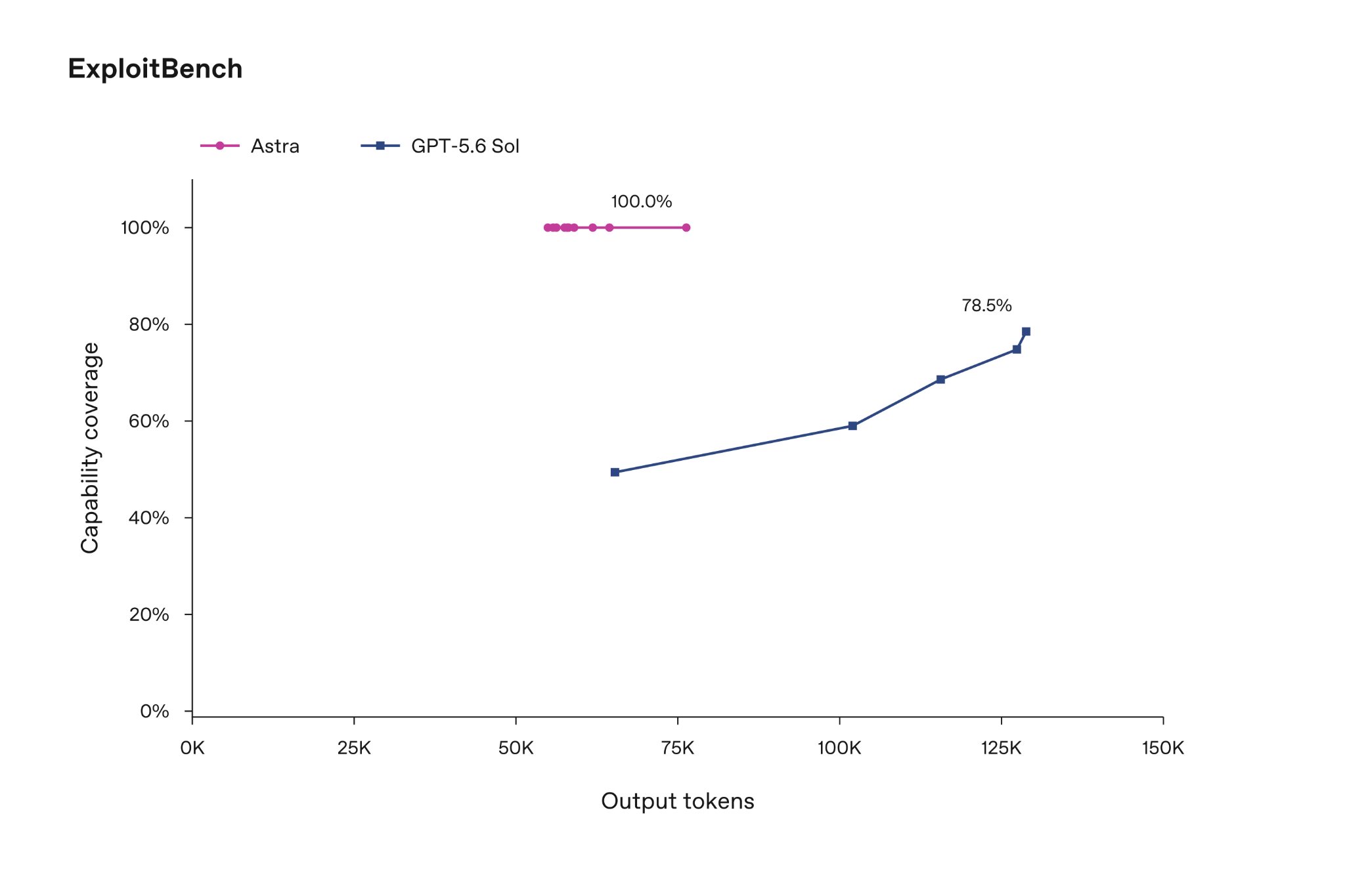
The important detail is the gate, not just the benchmark headline. OpenAI says Astra can identify and develop zero-day exploits. In tests run without production safeguards, the company reports 100% on ExploitBench and 42.4% on ExploitGym, compared with 78.5% and 30.3% for GPT-5.6 Sol. On a newer internal set covering 20 high-severity V8 vulnerabilities from June through August, OpenAI says Astra discovered and used two previously unknown zero-days that it is disclosing to maintainers.
The launch version is more constrained. OpenAI says it supports secure code review and patching but refuses advanced requests such as producing proof-of- concept exploits. Through Daybreak, the company plans to expand access in the coming weeks for verified defensive work including vulnerability validation, malware analysis, and detection engineering. The same release adds production monitoring that can pause or stop a task when it detects potentially unauthorized behavior.
Outside cyber, OpenAI reports a 59.3% result on Agents' Last Exam and 72.6% on an offline OSWorld 2.0 set. It says a Codex harness update makes computer-use tasks 1.9 times faster than the current GPT-5.6 Sol experience on Mind2Web. Those are vendor evaluations, but they explain the product positioning: Astra is meant to operate software, build artifacts, and complete multistep work, not just answer questions.
That makes Astra a useful test of a broader industry shift. Model launches are becoming portfolios of capability tiers, system cards, monitoring rules, and eligibility decisions. Buyers are no longer evaluating one static artifact. They are evaluating a model plus the operating system around it: who can use which feature, what evidence is collected, and what happens when a deployment crosses a risk threshold.
Why it matters
For builders, the practical question is whether an application can depend on a specific Astra behavior and access level over time. A staged release can be a responsible way to learn, but it also means product teams must plan for uneven availability, changing policy, and different controls between a general model and a high-capability tier. Enterprise access starts disabled and requires an administrator to turn it on. API pricing starts at $10 per million input tokens and $50 per million output tokens, with separate cache rates; OpenAI also offers a faster mode at twice the standard price.
For the safety debate, publishing a launch page, a safety overview, and an access roadmap gives observers more material than a single marketing post. But documentation earns trust through follow-through. The useful evidence will be concrete updates: which evaluations changed, which incidents altered deployment, how trusted-access decisions are made, and whether customers can tell when a safeguard is operating.
The release also raises the standard for competitors. Once a lab describes capability gating as part of a launch, other frontier providers will be asked to explain their own thresholds in similarly operational terms. That is a healthier comparison than a scoreboard made entirely from self-reported model benchmarks.
The fine print
All three sources are OpenAI publications, so the performance and safety claims are its own and need independent evaluation. OpenAI says production ChatGPT results may differ because prompts and tools differ. In evasion tests, Astra's written reasoning was harder to monitor than GPT-5.6 Sol's despite its stronger task-boundary results.
Astra's first product lesson is already visible: the model may be the star, but the access policy has a speaking role now.