What happened
The model page, updated in Google DeepMind's sitemap on September 4, describes Gemini 3.8 Flash Cyber as a specialist version of Google's fast model, tuned for autonomous vulnerability discovery and automated patching. Google says the model can navigate large codebases across 20 programming languages, identify hidden vulnerabilities, and generate validated fixes after discovery.
That pairing is the notable product choice. Security teams already have many tools that generate alerts. The scarce resource is often a high-confidence, reviewable patch that fits a codebase and survives tests. A model that can move from a suspected flaw to a proposed fix addresses the queue that forms after scanning, though a generated patch still needs human and automated review before it reaches production.
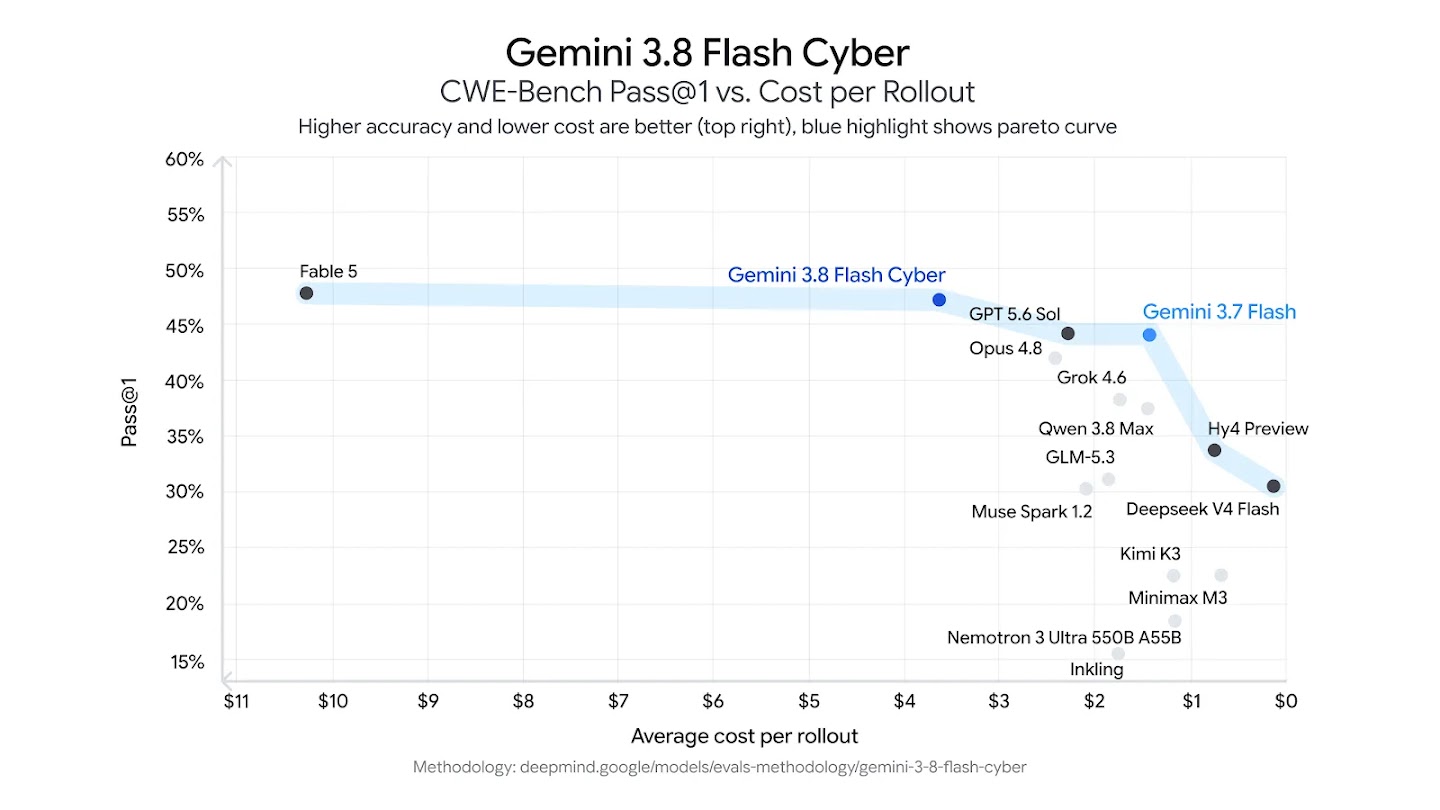
Google reports that the model sits on the cost-performance frontier of CWE-Bench with 47.2% pass@1, compared with 47.8% for Anthropic's Fable 5. The company also says its internal benchmark shows a vulnerability-discovery success rate above 70% across the 20-language suite. On CyberGym, Google says the model surpasses its previous 3.5 Flash Cyber and larger frontier models, but the public page does not reduce the result to a single prominently stated number.
The model also inherits prompt-injection work from the Gemini 3.8 family. Google points to gains on Gray Swan's indirect prompt-injection benchmark. That is relevant because cyber agents routinely ingest untrusted code, issue text, web pages, and logs. A malicious instruction hidden in those inputs can be as important as a flaw in the target code.
Access is restricted through the Fairwind Program, which Google describes as a way to give trusted defenders earlier access to advanced cyber capability while managing deployment. The public model page does not present the system as a general-purpose offensive tool.
Why it matters
Cybersecurity is becoming a proving ground for agents because success is measurable. A vulnerability either exists, a patch either blocks it, and tests either pass or fail. That makes the domain attractive for automation, but it also makes mistakes consequential. An agent can damage a service, expose data, or create an exploit while trying to prove a point.
The useful deployment pattern is therefore constrained autonomy. Give the model a reproducible sandbox, a bounded repository, non-production credentials, and tests that express the security property. Let it iterate quickly inside that boundary. Require review before merging or disclosure. Log the evidence that led from the finding to the fix.
The near-parity with a larger frontier model on CWE-Bench also illustrates why specialization matters. A smaller or faster model trained and scaffolded for a specific task can be more useful than a broadly capable model that costs more per attempt. In a workflow that needs many rollouts, the number of affordable, safe attempts may matter more than the prestige of the underlying model.
The fine print
The benchmark figures are reported by Google. CWE-Bench is external, but the specific run and the internal 20-language evaluation still need independent reproduction. A pass on a patch benchmark does not establish that a change is safe in a production system with undocumented dependencies and operational constraints.
The scanner can now hand you a patch. It has not volunteered to attend the incident review if you merge it without reading.